
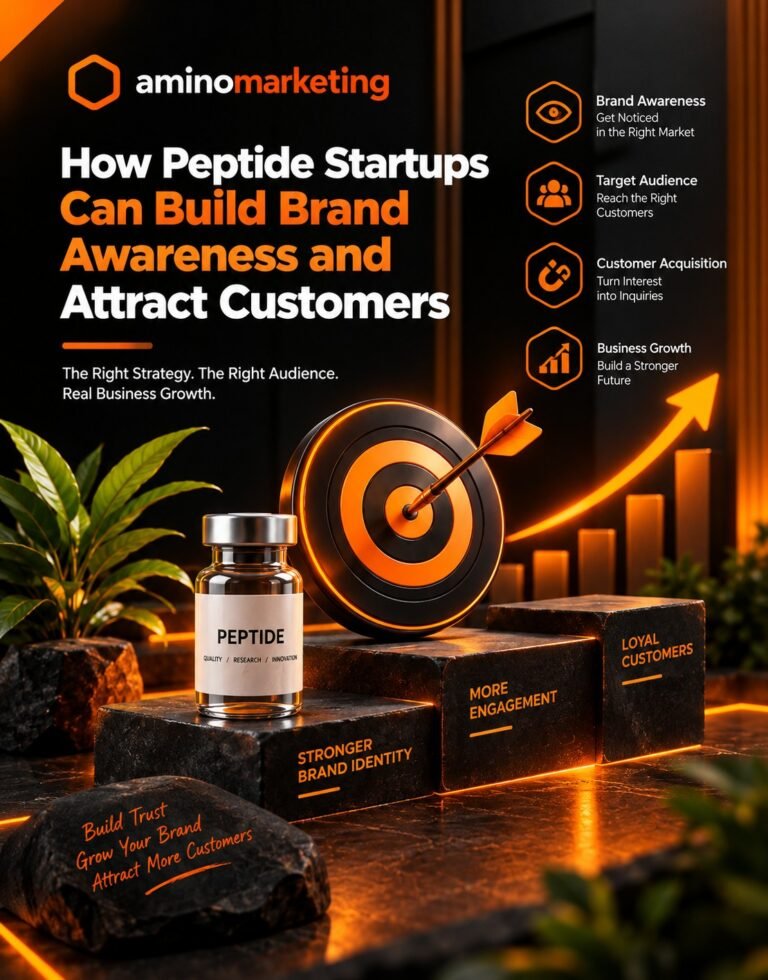
Launching a peptide business is only the beginning. The bigger challenge is establishing a recognizable brand, reaching the right audience, building credibility, and generating sustainable demand in a competitive market. Without a clear direction, startups can spend money on advertising, publish content without a purpose, and struggle to understand which activities actually contribute to business growth.
A well-structured digital marketing plan for a peptide startup connects marketing activities to measurable business objectives. Instead of treating SEO, paid advertising, email marketing, and social media as separate tasks, startups can coordinate these channels around a consistent brand position and a defined customer acquisition strategy.
Amino Marketing helps businesses approach digital growth through services that include SEO, paid advertising, web development, and email marketing. For peptide startups, the goal is to build a marketing approach that supports brand awareness, relevant traffic, meaningful engagement, and sustainable business development.
The process begins with understanding the market, identifying the right audience, and allocating resources to the channels that best support the company’s objectives.
Find Your Place in the Peptide Market
Before investing in campaigns, a startup needs to understand how it wants to be recognized. Peptide businesses may serve research organizations, healthcare-related audiences, cosmetic businesses, or other specialized markets. Each segment has different expectations, purchasing considerations, and information needs.
A successful digital marketing plan for a peptide startup begins with market positioning rather than immediately investing in traffic generation.
Understand Your Target Audience
Avoid defining your audience simply as people interested in peptides. That description is too broad to guide effective marketing.
Instead, identify the audience segments relevant to your business model. Consider their professional roles, business objectives, purchasing considerations, and preferred information sources.
For example, a company serving research institutions may need a different messaging approach from a business offering cosmetic peptide ingredients to qualified buyers.
Customer interviews, sales inquiries, website analytics, and market research can help reveal what matters to your audience. These insights also help shape a more focused peptide marketing strategy.
Communicate What Makes Your Brand Different
Your business needs a clear reason for potential customers to consider it. That reason might involve specialized product information, dependable customer support, transparent business practices, or a focused product range.
Avoid broad claims such as being the best or most innovative provider without evidence.
Effective peptide business marketing communicates a specific value proposition that the company can support. This gives advertisements, landing pages, social media content, and email campaigns a consistent direction.
Keep Your Brand Messaging Consistent
Your website, advertisements, social profiles, and email communications should present a consistent identity. Customers should be able to understand what your business offers and why it may be relevant to them.
Define the audience you serve, the value you provide, the evidence supporting your claims, and the next action you want visitors to take.
Consistent messaging strengthens peptide brand positioning and helps your startup build recognition within its chosen market.
Research Demand Before Investing in Marketing
Startups sometimes select marketing channels based on competitors’ activities or popular industry trends. However, a channel that works for one company may not suit another.
A practical digital marketing plan for a peptide startup uses market research to identify opportunities before committing significant resources.
Explore Competitor Strategies and Search Demand
Review competitors operating in the same market segment. Examine their positioning, website messaging, content themes, organic search visibility, and publicly visible marketing activities.
The goal is not to copy their campaigns. It is to understand which customer needs receive attention and where your business can provide a clearer or more useful experience.
Keyword research can reveal how audiences search for information, compare providers, and investigate products. Separate informational searches from commercial searches because each reflects a different stage of the customer journey.
Someone researching an industry topic may need educational information, while a potential business buyer comparing suppliers may need product specifications, business credentials, or purchasing details.
Focus on Opportunities With Business Value
Not every keyword or marketing opportunity deserves equal investment.
Evaluate opportunities based on relevance, search demand, competition, conversion potential, and alignment with your actual offerings.
This approach supports a stronger digital marketing strategy for peptide companies by helping startups prioritize activities that can contribute to business goals instead of chasing traffic alone.
Make Your Marketing Budget Work Harder
A limited budget makes prioritization especially important for early-stage companies. Spreading a small budget across too many channels can create fragmented campaigns that are difficult to evaluate.
A digital marketing plan for a peptide startup should establish a realistic budget based on business objectives, available resources, customer acquisition costs, and the time needed to assess results.
Allocate Resources to the Right Channels
Potential budget categories include:
- SEO and organic content development.
- Paid advertising, where the products, claims, and business model are eligible under applicable platform policies.
- Email marketing and customer relationship management.
- Website improvements and conversion tracking.
- Creative production, analytics, and campaign testing.
The appropriate allocation depends on the startup’s circumstances. A business with an established audience may prioritize retention and email marketing, while a company with limited organic visibility may need to invest more in search foundations and useful content.
A realistic peptide marketing budget should distinguish between initial setup costs and recurring expenses. Website development, analytics configuration, and initial content production may require upfront investment, while SEO maintenance, email campaigns, and content updates generally involve ongoing costs.
Scale Spending When the Data Supports It
Do not increase campaign spending simply because impressions or website sessions are rising.
Evaluate whether the traffic matches your target audience, whether visitors engage with relevant pages, and whether meaningful inquiries or purchases result.
The purpose of a digital marketing budget for startups is not to spend every available dollar. It is to direct resources toward activities that demonstrate credible potential to support growth.
Build Organic Visibility With a Focused SEO Strategy
SEO can help peptide startups become visible when relevant audiences search for information, services, or suppliers. Unlike short-term promotional campaigns, organic search can contribute to visibility over time, although rankings and results are not guaranteed.
An effective peptide SEO strategy should reflect the company’s specific market, website structure, and business objectives.
Match Keywords to Search Intent
Start by grouping keywords into meaningful themes, such as industry education, product information, supplier evaluation, and relevant commercial searches.
Map each keyword group to the most suitable page. This helps prevent multiple pages from competing for the same search intent.
Informational keywords may fit educational articles, while high-intent commercial keywords may belong on product, category, or service pages.
Effective SEO for peptide startups requires more than inserting keywords into headings. Pages should answer the searcher’s actual question, provide useful supporting information, and make the next step clear.
Strengthen Technical and On-Page SEO
Review essential technical and on-page elements, including:
- Crawlability and indexability.
- XML sitemap and robots.txt configuration.
- Page titles and meta descriptions.
- Heading structure and internal links.
- Broken links, redirects, and 404 errors.
- Mobile usability and page performance.
- Relevant structured data where appropriate.
These improvements help search engines access and interpret website content while giving visitors a better experience.
Connect Content With Commercial Goals
A startup should not publish articles solely to maintain a posting schedule.
Each article should address a defined audience need and connect naturally to a relevant next step. Useful content may answer common industry questions, explain product-selection considerations, clarify terminology, or help business buyers evaluate options.
A coordinated digital marketing plan for a peptide startup connects informational content with relevant commercial pages without forcing promotional messaging into every article.
Turn Content Into a Source of Brand Authority
Content marketing is most valuable when it strengthens the brand’s position and helps the audience make informed decisions.
For peptide businesses, accuracy and credibility are particularly important because scientific terminology, product claims, and intended uses can require careful handling.
Develop Content Around Real Audience Needs
Create content categories based on customer questions and business priorities. Depending on the company, these may include industry education, product documentation, research-related information, purchasing considerations, and business updates.
A useful peptide content marketing program gives every content format a clear purpose.
Blog articles can address informational searches, product pages can explain verified product details, FAQs can clarify recurring questions, and email newsletters can share relevant updates with opted-in subscribers.
Case studies can demonstrate documented business results when appropriate evidence and permission are available.
Avoid publishing repetitive articles that target nearly identical keywords without offering a distinct benefit.
Demonstrate Expertise and Credibility
Content should be accurate, clearly sourced where necessary, and reviewed by appropriately qualified people when scientific or technical claims require specialist knowledge.
Use transparent authorship, relevant credentials, reliable references, and clear business information where appropriate.
Businesses operating in regulated or sensitive markets should review applicable laws, industry requirements, and advertising restrictions before publishing claims.
Strong content supports peptide brand awareness while giving prospective customers more reasons to evaluate the business seriously.
Expand Brand Awareness Beyond Search Engines
Search visibility is important, but it should not be the only way a startup reaches potential customers.
A broader digital marketing plan for a peptide startup can combine suitable organic channels, professional networking, email communication, partnerships, and other relevant audience-building activities.
Choose Social Channels That Fit Your Audience
Not every social platform is appropriate for every peptide business. Select channels based on where your intended audience participates and what each platform permits.
Potential activities include sharing educational resources, highlighting company developments, explaining verified business capabilities, and participating in relevant professional discussions.
A consistent publishing schedule helps maintain visibility, but relevance and quality matter more than posting frequency alone.
Build Relevant Industry Relationships
Professional relationships can introduce your business to audiences that may not yet know your brand.
Depending on your business model, opportunities may include industry publications, professional events, educational collaborations, and partnerships with compatible organizations.
These activities should provide genuine value and comply with applicable disclosure requirements.
By focusing on relevant audiences instead of broad exposure, startups can strengthen their peptide brand positioning and develop more meaningful industry recognition.
Approach Paid Advertising With Careful Channel Selection
Paid advertising can provide access to targeted audiences, but peptide-related businesses must assess eligibility before launching campaigns.
Google Ads and Meta Ads have policies covering different product categories, healthcare-related claims, restricted goods, and other sensitive content. Eligibility depends on the actual product, intended use, claims, location, and current platform rules.
Therefore, do not assume every peptide business or product can be advertised through these channels.
Confirm Eligibility Before Launching Campaigns
Before developing campaigns, review applicable advertising policies and determine whether the business, product, landing page, and proposed claims are permitted.
Where direct advertising is restricted, do not attempt to bypass enforcement through misleading wording or disguised destinations.
Instead, prioritize eligible marketing activities, such as appropriate organic content, compliant email communication, professional relationships, and other lawful audience-development methods.
Measure Meaningful Campaign Outcomes
Where paid advertising is permitted, evaluate the relationship between spending and meaningful results.
Track qualified inquiries, conversion rates, cost per acquisition, and revenue where applicable. High click volume does not necessarily indicate that a campaign is reaching suitable customers.
A responsible digital marketing plan for a peptide startup includes clear criteria for continuing, revising, or stopping a campaign based on performance and compliance.
Strengthen Customer Relationships With Email Marketing
Email can help businesses maintain communication with people who have chosen to receive relevant updates. It can support education, product announcements, business updates, and customer retention, depending on the audience and applicable requirements.
Make Email Communication Relevant
Avoid sending the same message to every contact.
Where appropriate, segment subscribers by their stated interests, professional role, relationship with the business, or previous interactions. Keep data collection transparent and respect consent, privacy, and unsubscribe requirements.
Relevant communication can improve the customer experience without overwhelming subscribers with unnecessary promotions.
Create Useful Email Sequences
A startup might develop an onboarding sequence for new subscribers, a newsletter containing relevant updates, or follow-up communications related to a legitimate inquiry.
Each email should have a clear purpose and an appropriate next step.
Email performance should be assessed through meaningful engagement and business outcomes, not opens alone. Privacy protections and email-client changes can make open-rate data less reliable.
Including email in a broader digital marketing strategy for peptide companies helps connect audience development with ongoing communication, provided the messages and underlying business activities are appropriate.
Turn Website Visits Into Qualified Leads
Attracting visitors is only one part of growth. The next challenge is helping relevant prospects understand the business, evaluate its offering, and take appropriate action.
A well-designed digital marketing plan for a peptide startup identifies where prospective customers enter the marketing journey and what information they need before proceeding.
Make the Next Step Clear
Review the path from an initial interaction to a meaningful inquiry or transaction.
Consider whether visitors can understand the offering quickly, locate important information, assess the business’s credibility, and find a clear next step.
Depending on the business model, improvements may include clearer product information, accessible contact details, transparent policies, stronger page organization, or a simpler inquiry process.
Measure Lead Quality Instead of Traffic Alone
Not every inquiry represents a suitable prospect.
Where applicable, define what makes a lead qualified. This may include relevant business requirements, an appropriate use case, purchasing authority, or a genuine fit with the company’s offering.
Coordinate marketing and sales feedback to identify which channels generate the most useful inquiries.
This makes peptide customer acquisition a measurable business process rather than a simple exercise in increasing traffic.
Understand the Complete Customer Journey
A prospect may interact with several touchpoints before contacting the company. Depending on available data and consent requirements, analytics can help show how organic search, referrals, advertising, and email contribute to the journey.
Avoid attributing every conversion to the final click without considering other interactions.
Measure What Matters for Sustainable Growth
Without reliable measurement, a startup cannot confidently determine which marketing activities deserve additional investment.
The right KPIs depend on the company’s stage, goals, and available data.
Choose Metrics That Reflect Business Objectives
| Objective | Relevant KPI |
| Improve organic visibility | Organic impressions, clicks, and rankings |
| Attract relevant visitors | Qualified organic and referral sessions |
| Generate inquiries | Qualified leads and conversion rate |
| Evaluate acquisition efficiency | Cost per qualified lead or customer |
| Improve retention | Repeat purchases or customer retention, where applicable |
| Evaluate financial performance | Revenue, acquisition costs, and marketing ROI |
These measures should be interpreted together. An increase in impressions may indicate growing visibility, but it does not necessarily demonstrate higher revenue.
Use Reporting to Make Better Decisions
Use appropriate analytics and reporting tools to review performance regularly. Google Search Console can help monitor organic search performance, while analytics platforms and CRM systems can provide additional insight into visitor behavior and lead outcomes.
Check that tracking is configured correctly before relying on the data. Define conversion events consistently and account for privacy requirements.
A practical digital marketing plan for a peptide startup should help answer specific questions: Which channels attract the right audience? Which pages support inquiries? Where are potential customers dropping off? Which activities justify further investment?
Understand Marketing ROI Before Increasing Investment
Marketing return on investment can help businesses evaluate whether their spending contributes to financial results. However, calculations depend on the quality of attribution data, the sales cycle, and the costs included.
A basic ROI calculation is:
Marketing ROI = (Attributable return − marketing cost) ÷ marketing cost × 100
For example, if a campaign generates $8,000 in attributable profit before marketing costs and the campaign costs $2,000, the calculated ROI is 300%.
This example is illustrative. In practice, businesses should distinguish revenue from profit and account for relevant operating, fulfillment, and acquisition costs.
Use Early Results to Refine Your Budget
Startups may not have enough data to calculate reliable ROI immediately. Early campaigns can still provide useful information about audience engagement, lead quality, and conversion behavior.
Review performance over a period appropriate to the sales cycle, and avoid drawing strong conclusions from a handful of conversions.
Understanding peptide marketing ROI allows businesses to make more informed decisions about budget allocation, channel selection, and future campaign development.
Avoid Marketing Mistakes That Slow Growth
Even a well-funded startup can waste resources when its marketing activities lack coordination.
Common mistakes include targeting broad audiences without clear positioning, publishing repetitive content without defined search intent, spending on advertising before confirming eligibility, making unsupported product claims, measuring clicks without evaluating lead quality, and increasing budgets before establishing reliable tracking.
Other problems include inconsistent messaging across channels and neglecting customer feedback or website usability.
A clear digital marketing plan for a peptide startup reduces these risks by establishing priorities, assigning resources, and creating a consistent measurement process.
The objective is not to use every available channel. It is to select suitable activities, execute them carefully, and improve the approach as reliable evidence becomes available.
How Amino Marketing Supports Peptide Business Growth
Amino Marketing helps businesses develop digital marketing activities around their goals, audiences, and competitive environments. Its services include SEO, Google Ads, Meta Ads, web development, and email marketing.
For peptide startups, the right mix depends on the company’s business model, market position, growth stage, and the rules that apply to its products and claims.
Rather than treating each channel as an isolated task, Amino Marketing can help businesses evaluate how their marketing activities work together. This may involve improving organic search visibility, refining brand messaging, strengthening the website experience, developing relevant content, and evaluating eligible paid campaigns.
A structured digital marketing plan for a peptide startup should remain flexible enough to respond to market feedback while keeping core business objectives clear.
The priority is to build a consistent, measurable marketing approach that supports informed decision-making and sustainable development.
Get a Free Consultation
Planning your next stage of growth requires more than choosing a few marketing channels. It requires a clear understanding of your audience, positioning, budget, and performance goals.
Amino Marketing can help you evaluate relevant opportunities and identify marketing priorities that fit your peptide business.
Contact Amino Marketing to discuss your goals and explore suitable digital marketing services for your business.
Frequently Asked Questions
What should a peptide startup include in its digital marketing plan?
A plan should include audience research, brand positioning, keyword research, content marketing, suitable acquisition channels, a realistic budget, analytics, and measurable business goals. Advertising eligibility and relevant regulatory requirements should also be reviewed before campaigns begin.
How much should a peptide startup spend on marketing?
There is no universal budget that suits every startup. Spending depends on available capital, competition, business objectives, channel costs, and the company’s ability to convert qualified prospects. Begin with a realistic allocation and adjust it using reliable performance data.
Is SEO useful for peptide startups?
SEO can help relevant audiences find a business through organic search. Its value depends on search demand, competition, content quality, website accessibility, and alignment with the company’s offerings. Results can take time and are not guaranteed.
Can peptide businesses use Google Ads and Meta Ads?
Eligibility depends on the specific products, claims, intended uses, destination pages, location, and current platform policies. Businesses should verify the applicable requirements before launching campaigns and should not attempt to circumvent advertising restrictions.
How can peptide startups measure customer acquisition?
Businesses can track qualified inquiries, conversion rates, acquisition costs, sales outcomes, and retention where applicable. Accurate conversion tracking and consistent lead-quality definitions are essential for comparing channels meaningfully.
When should a peptide startup revise its marketing strategy?
Review the strategy when business objectives change, audience behavior shifts, channel performance remains weak, or reliable data identifies a better opportunity. Make changes based on evidence rather than reacting to short-term fluctuations alone.