
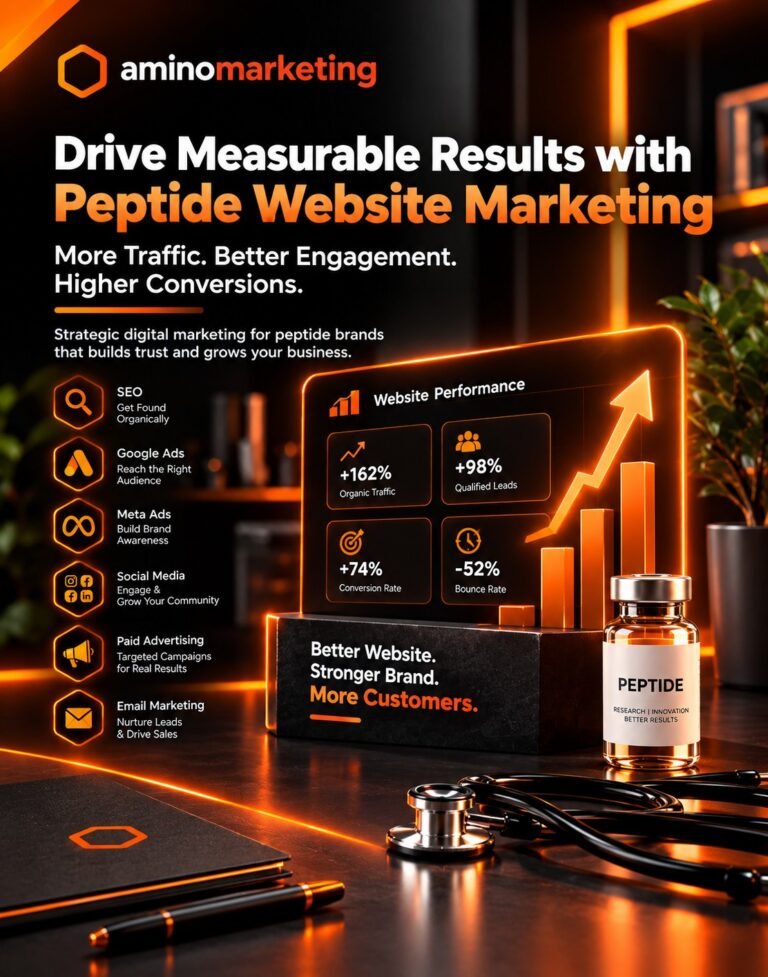
A peptide business needs more than a website to establish a strong position in a competitive digital market. It needs a clear marketing message, relevant online visibility, a consistent brand identity, and a website that helps the right audience understand its offerings. Without these elements working together, businesses can struggle to turn online attention into meaningful engagement and qualified inquiries.
Peptide website marketing connects website optimization with search engine visibility, content marketing, audience engagement, and suitable promotional channels. Rather than treating the website as an isolated asset, businesses can use it as the central point of their digital marketing activities.
At Amino Marketing, we help businesses develop coordinated digital marketing approaches that support visibility, audience acquisition, and measurable business goals. Our approach to peptide website marketing considers how website content, SEO, social media, and eligible advertising opportunities can work together to create a more consistent online presence.
Whether you are launching a new peptide website or improving an established one, the right marketing approach can help you communicate your brand’s value, reach relevant audiences, and build a stronger foundation for sustainable growth.
Why Peptide Website Marketing Matters for Brand Growth
A website provides potential customers with an important opportunity to learn about a business. However, simply publishing pages does not guarantee that the intended audience will find them or understand the company’s value.
Peptide website marketing helps connect website development with the activities that attract relevant visitors and encourage meaningful engagement.
Turn Your Website Into a Marketing Asset
Your website should communicate your business purpose, explain your offerings, and make relevant information easy to find. Visitors should understand what your company does without navigating through unrelated pages or interpreting unclear messaging.
A well-organized website can support several marketing objectives:
- Improve visibility for relevant search queries.
- Communicate your brand’s positioning and expertise.
- Provide useful information about your products or services.
- Direct visitors toward appropriate resources and contact options.
- Support campaigns across suitable digital channels.
When these elements work together, peptide website marketing becomes more than a website improvement task. It becomes part of a coordinated approach to online growth.
Build a Clear Brand Position
The peptide market includes businesses with different products, audiences, and objectives. A generic marketing message may not explain why your business is relevant to its intended customers.
Define what your brand offers, whom it serves, and what information visitors need to evaluate your business. Keep the same positioning across your homepage, service pages, educational content, and social media profiles.
Avoid unsupported claims, exaggerated promises, or statements that cannot be substantiated. Accurate communication helps establish a more professional and consistent brand experience.
Develop a Website That Supports Marketing Performance
A website should be designed around both audience needs and business objectives. Visual design matters, but navigation, content structure, accessibility, and conversion paths also influence how effectively the website serves its purpose.
Improve Website Navigation and User Experience
Visitors should be able to find important information quickly. Use clear menus, descriptive headings, logical page categories, and relevant internal links.
Make sure essential pages are easy to access, including company information, product or service details, contact information, and applicable policies.
Review your website on different screen sizes and browsers. Check whether buttons work properly, forms are easy to complete, and content remains readable on mobile devices.
These improvements can make peptide website marketing more effective by reducing unnecessary friction between a visitor’s arrival and their next step.
Improve Page Speed and Technical Performance
Slow pages and technical errors can disrupt the user experience. Regularly review page loading performance, broken links, redirect behavior, indexing issues, and other technical problems.
Use suitable image formats, avoid unnecessary scripts, and review the performance impact of plugins and third-party integrations.
Technical improvements should be prioritized according to their impact on users and search engine accessibility. A faster, more reliable website gives your marketing activities a stronger foundation.
Create Landing Pages for Specific Audiences
A landing page should address a clear topic or business objective. Rather than directing every visitor to the homepage, send them to a relevant page that matches their interests and the message that brought them to the website.
For example, a visitor interested in website development should land on a page explaining that service rather than a general page covering every aspect of the business.
Use a clear headline, accurate supporting information, relevant trust signals, and an appropriate call to action.
Strengthen Organic Visibility Through SEO
Search engine optimization can help peptide businesses become more visible for relevant queries. A useful SEO plan combines keyword research, on-page improvements, technical maintenance, and content that addresses genuine audience needs.
Build a Practical Keyword Strategy
Start by researching the terms your audience uses when looking for relevant businesses, services, and information.
Organize keywords according to search intent. Commercial searches may be suitable for service pages, while informational queries can guide educational blog content.
Avoid targeting the same search intent with multiple pages that offer nearly identical information. Keyword mapping helps each important page serve a distinct purpose.
For a business investing in peptide website marketing, this structure helps align the website with relevant search opportunities without creating unnecessary content overlap.
Improve On-Page SEO
Review the title tags, meta descriptions, headings, URLs, image alt text, and internal links on important pages.
Each page should have a clear topic and useful content that matches the expectations created by its title and search snippet.
Use related terms naturally where they improve clarity. Repeating keywords excessively can make content difficult to read and does not replace the need to provide genuinely useful information.
Resolve Technical SEO Issues
Technical SEO helps search engines discover, crawl, and understand website content.
Check for:
- Broken internal and external links.
- Incorrect redirects and missing pages.
- Duplicate or conflicting URLs.
- Sitemap and indexing problems.
- Missing or poorly implemented metadata.
- Slow page loading and mobile usability issues.
Review these areas regularly, especially after website redesigns or major content updates.
A technically sound website supports peptide website marketing by making important content easier to access while providing a better experience for visitors.
Use Content Marketing to Build Brand Authority
Content marketing gives businesses a way to answer audience questions, explain their expertise, and attract relevant organic traffic.
For peptide businesses, content should reflect the actual products or services offered and remain accurate, appropriate, and aligned with applicable requirements.
Publish Content Around Customer Questions
Develop articles that address the questions your intended audience asks before evaluating a business or choosing a service.
Depending on your business model, topics might cover website functionality, industry terminology, product information standards, digital visibility, or ecommerce website requirements.
Each article should provide a clear answer or useful perspective. Avoid publishing large volumes of repetitive content simply to increase the number of indexed pages.
Connect Blog Content With Commercial Pages
Educational articles can support the broader website by linking readers to relevant services or resources.
For example, a blog about website performance may link to a relevant website development service page. A resource about search visibility may direct readers to an appropriate SEO service.
This creates a natural path from information discovery to further engagement.
A coordinated content plan makes peptide website marketing more useful because articles can attract relevant visitors while supporting the website’s commercial objectives.
Integrate Social Media Marketing With Your Website
Social media can help businesses distribute content, maintain brand recognition, and engage with audiences through suitable platforms.
The objective is not necessarily to publish everywhere. Choose channels that align with your audience and the type of communication your business can maintain consistently.
Maintain Consistent Brand Messaging
Your website and social media profiles should communicate the same core brand message.
Use consistent visual elements, accurate descriptions, and relevant links to help people recognize your business across different channels.
For suitable businesses, peptide social media marketing may involve sharing educational resources, company updates, and relevant website content. The specific approach should reflect the audience, business model, and platform rules.
Turn Social Engagement Into Meaningful Website Visits
When sharing content, link to the page that best supports the message. An educational post may lead to a detailed article, while a service-related update may direct visitors to the relevant service page.
Monitor link clicks, meaningful engagement, and relevant website actions instead of judging performance solely by follower counts.
Social media should support the wider marketing plan rather than operate as a disconnected publishing activity.
Evaluate Paid Advertising Opportunities Carefully
Paid advertising can offer additional reach, but peptide-related campaigns require careful consideration of platform policies.
Eligibility can vary depending on the product, business model, destination website, intended audience, and claims used in advertising. Some products or promotional activities may be restricted or prohibited.
Before investing in a campaign, review the applicable policies and confirm that the intended promotion is permitted.
Review Peptide Google Ads Eligibility
Peptide Google Ads campaigns should only be considered after checking Google’s current advertising policies for the specific products and business model.
Do not assume that all peptide-related products can be advertised. A campaign’s eligibility may depend on product classification, claims, destination content, and other policy requirements.
Where advertising is permitted, align the keywords, ad copy, and landing page. Monitor relevant outcomes, including qualified inquiries and conversion performance, rather than focusing exclusively on impressions or clicks.
Assess Peptide Meta Ads Requirements
Peptide Meta Ads also require a careful review of current advertising rules.
Businesses should verify whether their products, claims, and destination pages are eligible before launching promotional campaigns. The appearance of similar advertisements online does not guarantee that a particular campaign is permitted.
For eligible campaigns, use accurate messaging, relevant creative assets, and a clear objective. Do not use misleading health claims or attempt to bypass platform restrictions.
Plan Peptide Paid Marketing Around Business Goals
Peptide paid marketing should not be treated as a guaranteed source of traffic or leads. First determine whether the intended campaign is permitted and whether the website is ready to receive relevant visitors.
When peptide paid advertising is allowed, establish a realistic budget, define measurable goals, and monitor campaign performance.
Advertising for peptide brands should prioritize accuracy, relevant targeting, and policy compliance. If a particular platform or product category is ineligible, focus on suitable alternatives rather than trying to circumvent the rules.
Build a Coordinated Peptide Digital Marketing Plan
Website optimization, SEO, content marketing, social media, and eligible advertising are most effective when they support a common business objective.
Peptide digital marketing should therefore be planned as a connected system rather than a list of unrelated tasks.
Align Website Content With Your Marketing Message
Your advertising, social media posts, blog articles, and website pages should communicate a consistent message.
If a campaign highlights a particular service or product category, the destination page should provide relevant information about that same subject.
Inconsistency can confuse visitors and weaken the connection between their initial interest and the information they find on your website.
Use Email Marketing to Maintain Engagement
Email can help businesses communicate with subscribers who have consented to receive messages.
Depending on the business model, email campaigns may share educational resources, company updates, service information, or relevant announcements.
Keep messages useful and accurate, respect subscriber preferences, and follow applicable privacy and marketing requirements.
Email should complement peptide website marketing by directing interested readers toward relevant website resources and maintaining consistent communication over time.
Measure the Results of Your Website Marketing
A website marketing plan should be evaluated using indicators that reflect actual business objectives.
Traffic alone does not show whether a website is attracting the right audience or helping visitors take meaningful actions.
Monitor Search Performance
Google Search Console can help you review impressions, clicks, click-through rate, average position, and the queries associated with your website.
Identify pages that receive search impressions but relatively few clicks. Review whether their titles and descriptions accurately communicate the page’s value and align with search intent.
Also monitor important landing pages to understand which queries are generating visibility and whether those pages provide the information visitors expect.
Track Engagement and Conversions
Use appropriate analytics tools to monitor traffic sources, important page visits, inquiry form submissions, and other meaningful actions.
If a page receives visitors but generates few inquiries, review the page’s relevance, content, user experience, and call to action before assuming that the solution is simply to increase traffic.
Measure performance consistently and prioritize changes based on reliable evidence.
These practices help make peptide website marketing more accountable and give businesses a clearer basis for improving their digital activities.
How Amino Marketing Supports Peptide Website Marketing
Amino Marketing helps businesses coordinate digital marketing activities around their audiences, brand positioning, and growth objectives.
Our services include SEO, website development, Google Ads, Meta Ads, email marketing, and conversion-focused digital strategies. The appropriate combination depends on the business’s needs, target market, and the platforms or promotional activities it can use compliantly.
For peptide businesses, peptide website marketing can involve improving the website experience, developing useful content, strengthening organic search visibility, and evaluating appropriate promotional opportunities.
Our approach emphasizes:
- Website and landing page improvements that support clear messaging and relevant visitor actions.
- SEO and content planning that target appropriate search intent.
- Brand consistency across relevant digital channels.
- Performance measurement to evaluate traffic quality and meaningful conversions.
- Careful campaign assessment that accounts for applicable advertising restrictions.
As a peptide marketing agency, Amino Marketing can help businesses evaluate their digital marketing opportunities and coordinate suitable activities. Recommendations for peptide advertising depend on the specific products, business model, and current platform requirements.
The goal is to build a more consistent online presence and help businesses make informed decisions about their marketing investments.
Get a Free Consultation
Is your peptide business attracting website visitors but struggling to turn that attention into meaningful engagement?
Amino Marketing can help you review your digital marketing approach, identify opportunities for improvement, and develop a plan aligned with your business objectives.
From SEO and content planning to website development and eligible promotional activities, we focus on connecting marketing efforts with measurable goals.
Get a Free Consultation with Amino Marketing to discuss your website, evaluate your marketing opportunities, and identify practical next steps for strengthening your online presence.
Frequently Asked Questions
1. What is peptide website marketing?
Peptide website marketing combines website optimization with SEO, content marketing, audience engagement, and suitable promotional activities to improve online visibility and support business goals.
2. Why is website marketing important for peptide businesses?
Website marketing helps businesses communicate their offerings, improve search visibility, provide relevant information, and guide visitors toward appropriate next steps. Its effectiveness depends on website quality, audience relevance, and the marketing activities implemented.
3. Can peptide businesses use Google Ads or Meta Ads?
Eligibility depends on the specific products, business model, advertising claims, landing pages, and current platform policies. Businesses should verify eligibility before launching campaigns because certain products or promotional activities may be restricted.
4. How can SEO improve peptide website performance?
SEO can improve a website’s visibility for relevant searches through useful content, keyword mapping, on-page optimization, internal linking, and technical improvements. Results vary according to competition, website quality, and ongoing implementation.
5. What should a peptide website marketing strategy include?
A strategy may include website improvements, SEO, useful content, social media, email communication, analytics, and eligible paid advertising. The right combination depends on the business’s objectives, audience, and applicable requirements.
6. How can I measure peptide website marketing success?
Track relevant metrics such as organic clicks, qualified website visits, inquiry submissions, conversion rates, and the performance of individual marketing channels. Choose metrics that align with your actual business goals rather than relying on traffic alone.
7. Why work with a peptide marketing agency?
A specialized agency can help businesses coordinate website improvements, SEO, content, and appropriate promotional activities. Its value depends on its expertise, communication, and ability to align marketing work with the business’s goals and constraints.