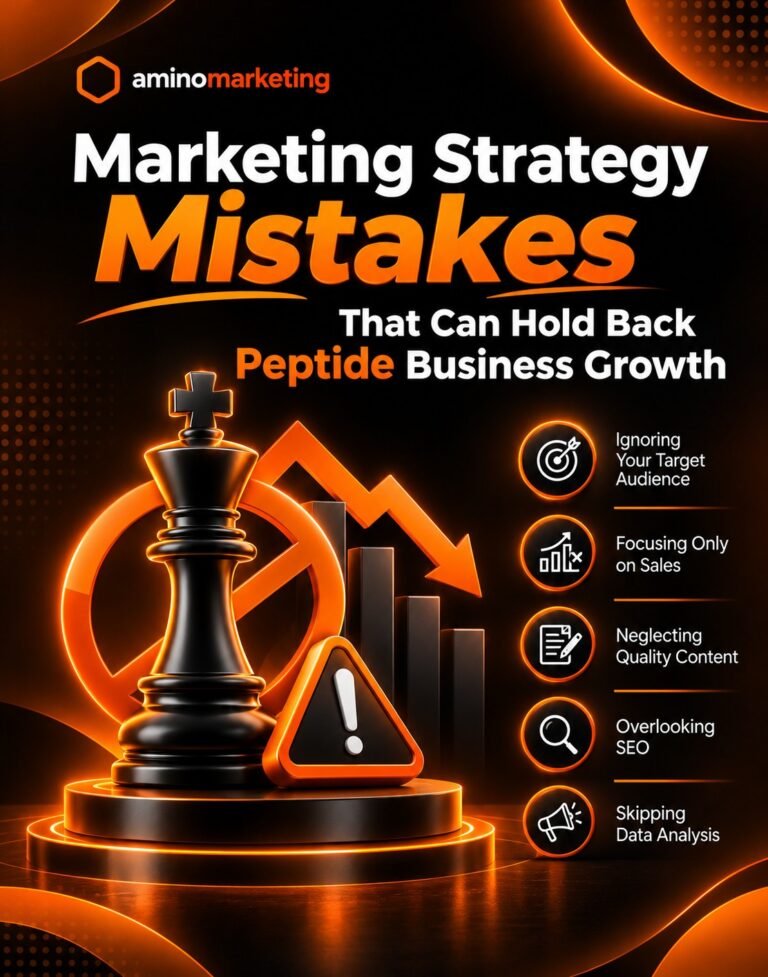
Growing a peptide business in a competitive industry requires more than launching campaigns or maintaining social media profiles. Companies need a clear understanding of their audiences, a consistent brand message, and a marketing approach that connects different activities with measurable business objectives.
Many businesses invest in digital marketing but struggle to achieve meaningful results because their efforts lack direction. They may target the wrong audiences, rely on disconnected campaigns, overlook customer engagement, or fail to evaluate whether their marketing activities are contributing to business growth.
Digital Marketing Mistakes for Peptide Businesses are not always related to a lack of marketing activity. In many cases, the real problem is how campaigns are planned, managed, and evaluated.
A successful approach requires businesses to understand their market, select suitable channels, communicate their value clearly, and continuously improve their marketing decisions.
At Amino Marketing, we help peptide businesses develop more coordinated digital marketing approaches through SEO, advertising management where permitted, social media, email marketing, and strategic marketing support. Our goal is to help businesses strengthen their market presence and make more informed marketing decisions.
Relying on Marketing Activities Without a Clear Strategy
One of the most common Digital Marketing Mistakes for Peptide Businesses is investing in multiple marketing activities without establishing a clear direction.
Publishing social media posts, running campaigns, and producing blog content can create activity, but these efforts may not deliver meaningful results if they are not connected to specific business objectives.
A structured Peptide Marketing Strategy should define what the business wants to achieve and how different marketing channels will contribute to those goals.
Before launching campaigns, businesses should establish:
- Their primary marketing objectives.
- The audiences they want to reach.
- Their brand positioning and value proposition.
- The digital channels relevant to their business.
- Content and campaign priorities.
- Key performance indicators for evaluating results.
For example, a company focused on increasing brand recognition may prioritize consistent content distribution and organic visibility. Another business may focus on generating qualified inquiries through suitable channels.
Both approaches require different priorities and performance indicators.
A clear strategy prevents marketing efforts from becoming disconnected and helps businesses allocate resources more effectively.
Targeting the Wrong Audience
Even well-developed marketing campaigns can underperform when they reach people who are not relevant to the business.
Poor audience research is another important example of Digital Marketing Mistakes for Peptide Businesses. Companies sometimes focus on reaching the largest possible audience instead of identifying the people who are most relevant to their offerings.
Peptide Customer Acquisition begins with understanding who the business wants to attract and what information those audiences need.
Businesses should evaluate:
- Relevant audience segments.
- Industry interests and professional backgrounds.
- Common questions and information requirements.
- Preferred communication channels.
- Existing customer feedback.
- Audience engagement patterns.
This information can help companies develop more relevant messaging and select suitable marketing channels.
Audience targeting should also reflect the actual business model. A company serving industry professionals may require a different communication approach from one addressing another permitted market segment.
Businesses should avoid broad assumptions and unsupported audience claims. Marketing decisions should be based on relevant research and accurate information.
Depending on a Single Marketing Channel
Another common issue is relying too heavily on one source of visibility. A business may depend entirely on organic search, social media, or advertising without considering other suitable opportunities.
Peptide Digital Marketing should be planned around the company’s objectives and the channels that can realistically support them.
Different channels serve different purposes:
SEO: Helps businesses improve organic visibility through relevant search terms, optimized content, and search-friendly pages.
Social Media: Provides opportunities to communicate brand messages, share useful information, and maintain audience engagement.
Email Marketing: Supports ongoing communication with subscribers through relevant updates and informational campaigns.
Content Marketing: Helps companies address audience questions and communicate their industry focus.
Paid Advertising: May provide additional reach through eligible campaigns, depending on the advertised products or services and applicable platform policies.
The objective is not to use every available platform. It is to identify suitable channels and coordinate them under one marketing direction.
Relying on a single channel can create unnecessary dependency. A balanced approach gives businesses more opportunities to communicate with relevant audiences.
Treating Brand Messaging as an Afterthought
A company can publish content across several platforms and still struggle to establish a recognizable identity if its messaging is inconsistent.
Peptide Business Marketing should communicate a clear and consistent message about what the company represents, who it serves, and what makes its approach distinctive.
Businesses sometimes use different descriptions, visual styles, and communication tones across their website, social media profiles, and marketing campaigns. This can create confusion and weaken brand recognition.
A consistent messaging framework should include:
- A clear brand introduction.
- Defined business positioning.
- Consistent terminology.
- Recognizable visual elements.
- Accurate descriptions of products or services.
- A suitable tone of communication.
Every campaign should reinforce the company’s established identity rather than introducing unrelated messages.
Strong messaging makes it easier for audiences to understand a business and recognize it across different digital interactions.
Ignoring Search Intent and Organic Marketing Opportunities
SEO is more than adding keywords to blog posts or publishing articles regularly. Businesses need to understand what their intended audiences are searching for and create content that addresses those interests.
Some Peptide SEO Mistakes include targeting unrelated keywords, ignoring search intent, publishing repetitive content, and failing to connect informational resources with relevant business pages.
A more effective SEO approach should include:
Keyword Research: Identify search terms relevant to the company’s market and business objectives.
Search Intent Analysis: Understand whether users are looking for educational information, business details, or specific services.
Content Planning: Create useful resources that address relevant topics without unnecessary repetition.
Internal Linking: Connect related articles and existing service pages.
Performance Monitoring: Review impressions, clicks, rankings, and organic traffic to understand content performance.
SEO should also be treated as a long-term marketing channel. Businesses need to review their content and identify opportunities for improvement rather than expecting immediate results from every published article.
Combining organic search with other suitable marketing activities can create a more consistent approach to online visibility.
Overlooking Content Distribution and Audience Engagement
Creating valuable content is only one part of an effective content strategy. Businesses also need to consider how that content reaches their intended audiences.
Peptide Content Marketing can lose its effectiveness when companies publish articles without a clear distribution plan.
For example, a business may invest time in producing informative blog posts but fail to share them through relevant channels or connect them with other marketing activities.
A structured distribution approach can include:
- Sharing relevant articles through suitable social media platforms.
- Including useful resources in email newsletters.
- Linking related content across the website.
- Repurposing articles into suitable informational formats.
- Using performance data to identify topics that attract engagement.
Businesses should also maintain content quality and accuracy. Research-related and health-related topics require particular care to avoid unsupported medical, safety, or performance claims.
The purpose of distribution is to make relevant information accessible to the right audience, not simply to increase the number of promotional posts.
Underestimating Social Media Planning
Maintaining social media accounts without a defined plan can lead to inconsistent publishing and repetitive communication.
Peptide Social Media Marketing should support the company’s broader marketing objectives rather than operate as an isolated activity.
A social media plan should establish:
- Relevant platforms for the intended audience.
- Content themes and publishing priorities.
- Consistent brand presentation.
- Appropriate communication guidelines.
- Audience engagement practices.
- Performance indicators.
Businesses can share educational information, industry updates, company announcements, and relevant resources where appropriate.
They should also pay attention to comments, recurring questions, and audience interactions. These can provide useful insights for future content development.
However, peptide-related businesses should review platform rules before publishing promotional content or launching paid campaigns. Different products and services may be subject to specific restrictions.
Consistent and relevant social media communication can strengthen brand familiarity while supporting the wider marketing plan.
Ignoring Advertising Policies and Campaign Requirements
Paid advertising can provide businesses with opportunities to reach audiences, but peptide-related campaigns require careful consideration of platform requirements.
Peptide Advertising Challenges can arise because advertising platforms may restrict certain products, claims, and promotional content. Eligibility depends on the specific product or service, campaign material, platform policies, and applicable regulations.
A common mistake is planning advertising campaigns before reviewing whether the intended promotion is permitted.
Businesses should consider:
- Reviewing current platform advertising policies.
- Understanding restrictions related to the advertised product or service.
- Avoiding unsupported health, medical, or performance claims.
- Ensuring that campaign messages accurately represent the business.
- Reviewing landing pages and promotional material for compliance.
- Monitoring policy updates and campaign status.
Businesses should never attempt to bypass advertising restrictions or disguise prohibited promotions.
Where campaigns are eligible, advertising objectives, audience selection, creative materials, and landing pages should be planned carefully.
Understanding these requirements before investing in campaigns can help businesses make better decisions and avoid unnecessary disruptions.
Focusing on Traffic Instead of Meaningful Lead Generation
Increasing website traffic does not automatically result in more qualified inquiries. Businesses need to understand whether their marketing activities are attracting relevant visitors and encouraging appropriate next steps.
One of the overlooked Digital Marketing Mistakes for Peptide Businesses is treating traffic growth as the only measure of marketing success.
Peptide Lead Generation should be evaluated through meaningful interactions rather than visits alone.
Businesses should consider:
Lead Quality: Determine whether inquiries come from audiences relevant to the company’s business objectives.
Campaign Relevance: Review whether marketing messages accurately reflect the business and attract appropriate interest.
Conversion Tracking: Monitor important actions such as contact form submissions and consultation requests.
Follow-Up Processes: Establish a suitable process for responding to legitimate inquiries.
Landing Page Alignment: Ensure that campaign messages and destination pages communicate consistent information.
Companies should also review where visitors leave the customer journey and identify possible improvements.
A marketing approach that attracts fewer but more relevant visitors may be more valuable than one that generates large amounts of unrelated traffic.
Failing to Measure Marketing Performance
Marketing decisions should be supported by data rather than assumptions. Without regular reporting, businesses may continue investing in activities that are not contributing to their objectives.
Peptide Marketing Performance should be evaluated using metrics that reflect the purpose of each marketing channel.
Useful indicators include:
- Organic search impressions and clicks.
- Keyword ranking trends.
- Website traffic by acquisition source.
- Social media reach and engagement.
- Email campaign performance.
- Qualified inquiries and conversion actions.
- Campaign costs and eligible advertising results.
Businesses should use tools such as Google Analytics 4 and Google Search Console to understand website and organic search performance. Other channel-specific reporting tools can provide additional insights.
It is also important to distinguish between visibility metrics and actual business outcomes. An increase in impressions does not necessarily mean that a company has generated more leads or customers.
Regular reporting helps identify which activities are performing well, where improvements are needed, and how the marketing plan should evolve.
Neglecting Customer Retention and Follow-Up
Marketing should not stop once someone becomes familiar with a business or submits an inquiry. Maintaining communication and building long-term relationships are also important parts of sustainable business development.
Some companies concentrate entirely on attracting new audiences while overlooking existing subscribers, customers, and legitimate business inquiries.
A more complete approach should include:
- Timely responses to relevant inquiries.
- Consistent and appropriate email communication.
- Useful informational updates.
- Clear customer communication processes.
- Regular review of customer feedback.
- Opportunities to improve the overall experience.
Email marketing can support ongoing communication by sharing relevant company updates and resources with people who have appropriately subscribed.
Businesses should also respect consent requirements and provide suitable options for managing email preferences.
Building stronger relationships can support long-term business objectives and make marketing efforts more sustainable.
Failing to Adapt Marketing Activities as the Business Grows
A marketing approach that works during the early stages of a business may not remain suitable as the company expands.
Changes in audience needs, market competition, business objectives, and digital platforms can all influence marketing requirements.
A strong Peptide Business Growth Strategy should include regular reviews of marketing priorities and opportunities for improvement.
Businesses should evaluate:
- Whether current audience segments remain relevant.
- Which channels contribute meaningfully to business objectives.
- Whether brand messaging needs refinement.
- Which content topics deserve further development.
- Whether marketing resources are being allocated effectively.
- How market changes affect the company’s positioning.
Marketing should evolve alongside the business rather than remain fixed around outdated assumptions.
Regular evaluation helps companies identify new opportunities while maintaining consistency in their overall brand direction.
How Amino Marketing Helps Peptide Businesses Improve Their Marketing Approach
At Amino Marketing, we understand that effective marketing requires coordination between different channels, consistent brand communication, and a clear understanding of business objectives.
Peptide companies may face challenges involving organic visibility, campaign planning, audience engagement, and marketing performance. Addressing these areas requires an approach that considers the complete digital marketing environment.
We support businesses through:
SEO Services: Improving organic search visibility through keyword research, technical SEO, content optimization, and ongoing performance analysis.
Google Ads Management: Supporting eligible advertising campaigns through structured planning, campaign management, and performance monitoring in accordance with applicable Google Ads policies.
Meta Ads Management: Helping businesses manage suitable Meta advertising campaigns while following platform restrictions and requirements.
Social Media Marketing: Developing consistent communication and content approaches that reflect the company’s brand identity.
Email Marketing: Supporting ongoing audience communication through structured email campaigns and relevant content.
Website Development: Creating professional digital platforms that support brand communication, usability, and business requirements.
Our approach focuses on helping businesses connect these activities through a coordinated marketing direction rather than treating each service as a separate task.
Whether a company needs stronger organic visibility, improved audience engagement, or a more organized marketing plan, Amino Marketing can help develop an approach aligned with its business objectives.
Want to improve your marketing approach and avoid common digital marketing mistakes? Amino Marketing can help you identify opportunities, strengthen your digital presence, and build a more coordinated marketing plan.
Get a Free Consultation with Amino Marketing to discuss your marketing requirements and business goals.
Build a More Effective Marketing Approach for Long-Term Growth
Avoiding marketing mistakes requires more than increasing campaign activity or publishing content more frequently. Businesses need to understand their audiences, communicate a consistent identity, select suitable marketing channels, and evaluate their performance regularly.
Digital Marketing Mistakes for Peptide Businesses can affect every stage of the customer journey, from initial brand discovery to audience engagement and lead generation.
A well-planned approach helps businesses identify these problems and make more informed decisions about their marketing activities.
From SEO and content planning to suitable advertising, social media communication, and performance reporting, every activity should contribute to a clear business objective.
At Amino Marketing, we believe that consistent planning and ongoing improvement are important foundations for sustainable digital growth.
Ready to improve your peptide business marketing? Contact Amino Marketing to discuss a digital marketing approach that supports your brand and long-term objectives.
Frequently Asked Questions
What are the most common digital marketing mistakes for peptide businesses?
Common mistakes include lacking a clear marketing strategy, targeting the wrong audience, relying on one channel, using inconsistent messaging, ignoring SEO, and failing to measure campaign performance.
Why do peptide marketing campaigns sometimes fail?
Campaigns may underperform because of poor audience research, unclear objectives, unsuitable channel selection, inconsistent messaging, weak follow-up processes, or failure to monitor results. Advertising restrictions can also affect campaign eligibility.
How can peptide businesses improve their digital marketing strategy?
Businesses can improve their approach by defining clear objectives, understanding their audiences, coordinating suitable marketing channels, creating relevant content, and regularly reviewing performance data.
How important is SEO for peptide business growth?
SEO can help businesses improve organic visibility and attract relevant search traffic. A consistent approach to keyword research, content quality, technical optimization, and performance monitoring supports long-term search marketing efforts.
How can peptide companies improve lead generation?
Companies can improve lead generation by attracting relevant audiences, creating clear marketing messages, providing useful information, tracking meaningful conversion actions, and maintaining appropriate follow-up processes.
How should peptide businesses evaluate marketing performance?
Businesses should review channel-specific metrics such as search visibility, organic traffic, audience engagement, email performance, qualified inquiries, and suitable campaign results. The metrics should reflect the company’s actual marketing objectives.