
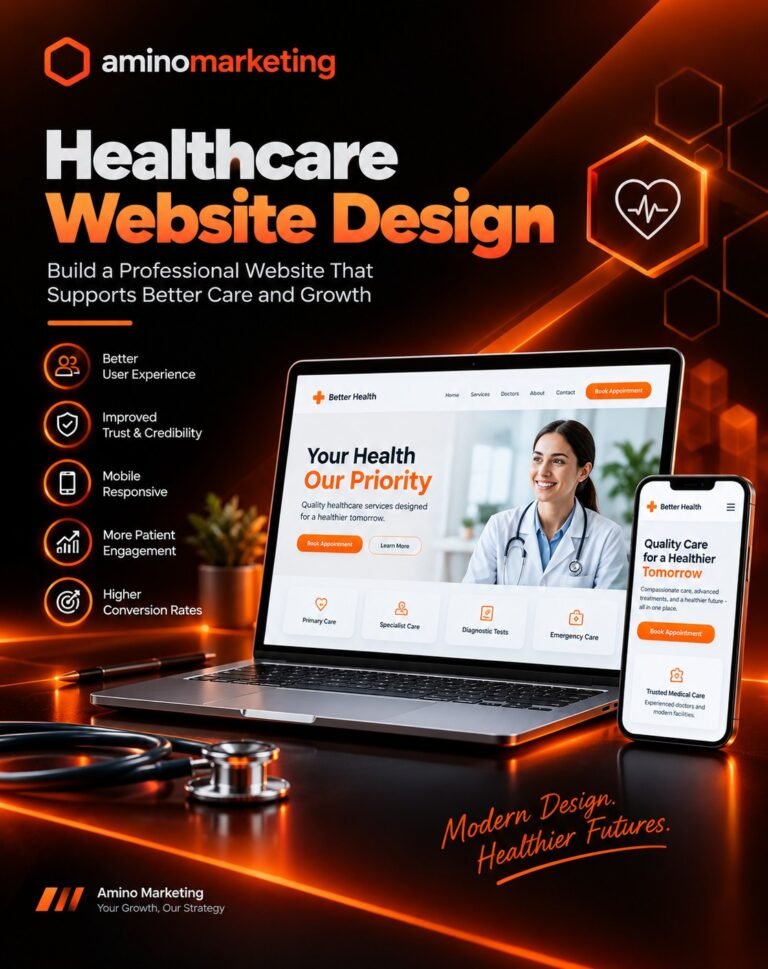
A healthcare website should do more than tell people who you are. It should help them understand your services, trust your brand, find the information they need, and take action. When the website fails to do those things, even strong marketing campaigns can struggle to produce meaningful results.
That is where healthcare website design becomes an important part of your overall digital marketing strategy.
At Amino Marketing, we approach healthcare website design with both the user and the business in mind. A website should not simply look professional. It should create a clear journey from the first visit to the next meaningful action, whether that means submitting an inquiry, booking an appointment, contacting a provider, or exploring a service.
The strongest healthcare websites bring together design, development, content, usability, performance, and marketing into one connected experience.
Healthcare Website Design Should Start With the User
Before thinking about colors, layouts, animations, or other visual elements, it is important to understand who will actually use the website.
Healthcare websites can serve patients, families, professionals, organizations, and other audiences. Each visitor may arrive with a different question or objective.
Good healthcare website design considers these different journeys and makes it easy for visitors to find the information that matters to them.
Someone searching for a specific service should not have to browse through several unrelated pages. Someone ready to contact the organization should not have to search for a phone number or form.
The website should guide people naturally.
This means the design process should begin with questions such as:
- Who is visiting the website?
- What are they looking for?
- What information do they need before taking action?
- Which services matter most?
- What actions should visitors take?
- Where might visitors leave the website?
Answering these questions creates a much stronger foundation for healthcare web design.
Build the Website Around Clear Goals
A healthcare website can have multiple goals, but they should be clearly defined.
For some organizations, the main goal may be appointment requests. For others, it could be generating inquiries, promoting specific services, increasing calls, or educating visitors.
Healthcare website design should reflect those objectives.
For example, if generating inquiries is a major goal, contact options should be easy to find throughout the website. If a particular service is a major growth area, that service should receive appropriate visibility within the navigation and content structure.
This prevents the website from becoming a collection of disconnected pages.
Instead, every major section can contribute to a larger digital growth objective.
Create a Homepage That Communicates Value Quickly
The homepage is often the first major touchpoint between your organization and a potential customer or patient.
Healthcare website design should make the value of the organization clear without forcing visitors to read everything on the page.
A strong homepage can quickly communicate:
- Who the organization serves
- What services are offered
- What makes the organization different
- Where the organization operates
- Why visitors should trust the brand
- What visitors should do next
Visual hierarchy plays an important role here.
The most important information should receive the most attention, while supporting information should remain easy to access without competing for attention.
This approach makes the website easier to understand and creates a more focused user experience.
Make Service Pages Part of the Marketing Journey
Service pages should not simply describe what an organization offers.
They should help visitors move closer to a decision.
Effective healthcare website design gives each important service its own clear destination, with useful information and relevant next steps.
A service page can answer common questions, explain the benefits or process, introduce relevant professionals, provide supporting resources, and guide visitors toward contacting the organization.
This is especially valuable when traffic comes from search engines or paid campaigns.
Instead of sending every visitor to a generic homepage, marketing campaigns can direct people to pages that closely match their intent.
That creates a more relevant experience from the first click.
Healthcare Website Design and Conversion Paths
Getting people to a website is only one part of digital marketing.
The next challenge is helping them take action.
This is where conversion-focused healthcare website design becomes important.
A conversion path should feel natural. Visitors should understand what they can do next without being pressured.
Depending on the organization, this could include:
- Booking an appointment
- Requesting information
- Calling a location
- Submitting a contact form
- Scheduling a consultation
- Exploring a service
- Downloading a resource
Calls to action should appear at relevant points throughout the user journey.
A visitor who has just learned about a service may need more information, while someone who has already reviewed the service details may be ready to contact the organization.
Good design recognizes this difference.
Healthcare Web Design Should Reduce Friction
Every unnecessary step creates another opportunity for a visitor to leave.
Healthcare web design should therefore make common actions as simple as possible.
Forms should be straightforward. Navigation should be predictable. Important information should be easy to locate. Buttons should clearly communicate what happens when someone clicks them.
Even small improvements can make the website feel significantly easier to use.
For example, instead of hiding contact information on one page, an organization can make contact options visible throughout the website.
Instead of forcing users to scroll through long pages, information can be divided into clear sections.
These decisions are part of effective healthcare website design because they focus on what visitors actually need.
Build for Mobile Visitors From the Beginning
A website needs to work well across desktops, tablets, and smartphones.
Mobile healthcare website design should account for how people interact with smaller screens.
Navigation needs to remain accessible. Buttons need enough space to tap comfortably. Text should remain readable. Forms should be easy to complete. Important information should not disappear behind complicated layouts.
A responsive website also provides a more consistent experience when visitors move between devices.
Mobile design should therefore be part of the original process rather than something added after the desktop version is complete.
Healthcare Website Development Creates the Foundation
Design determines how the website looks and feels, but healthcare website development determines how the experience actually works.
A strong development foundation allows the website to support the functionality required by the organization.
Depending on the project, this may involve:
- Appointment forms
- Contact forms
- Provider directories
- Location functionality
- Service databases
- Search features
- Content management systems
- Marketing integrations
- Analytics
- Third-party tools
The technical foundation should support the design rather than create limitations.
This is why healthcare website design and healthcare website development should be considered together.
Performance Should Be Part of the Design
A visually impressive website can still create a poor experience if it takes too long to load.
Large images, unnecessary scripts, excessive animations, and poorly optimized resources can make pages slower and less enjoyable to use.
Modern healthcare website design should balance visual quality with performance.
Aminо Marketing considers performance as part of the broader website experience, because a faster and more efficient website can help visitors move through the site with less friction.
Performance improvements may involve image optimization, efficient code, responsive layouts, caching, hosting, and technical improvements.
Build Trust Into Every Page
Healthcare-related decisions often require a higher level of trust.
Visitors may want to know who operates the organization, who provides the services, where it is located, and how they can get in touch.
Healthcare website design should make these details easy to find.
Trust can be strengthened through professional branding, clear team information, transparent contact details, useful educational content, consistent messaging, testimonials where appropriate, and a polished overall experience.
Trust should not exist only on an “About” page.
It should be reflected throughout the entire website.
Connect Healthcare Website Design With SEO
Search visibility and website design should not operate independently.
A website may have excellent content, but if its architecture is difficult for users and search engines to understand, that content may not perform as effectively as it could.
Healthcare website design should provide a strong foundation for search-friendly architecture.
This can include:
- Logical page structures
- Clear headings
- Search-friendly URLs
- Internal linking
- Descriptive metadata
- Mobile responsiveness
- Fast-loading pages
- Well-organized content
This connection between design and search visibility can help healthcare organizations create a website that works for both people and search engines.
Use Content to Support the Website Experience
Healthcare websites often need to explain complicated topics in a way that feels simple and accessible.
Content should therefore be integrated into the design rather than treated as an afterthought.
Healthcare website design can create space for educational articles, FAQs, resources, service explanations, guides, and other useful information.
These resources can answer questions that visitors may have before contacting the organization.
They can also create additional opportunities to attract people through organic search and guide them toward relevant services.
This creates a connection between healthcare web design, content marketing, and search visibility.
Create Landing Pages for Marketing Campaigns
Paid campaigns and other marketing channels often work better when visitors land on a page specifically designed for the campaign.
Sending every visitor to the homepage can create a disconnect between the advertisement and the website.
Instead, dedicated landing pages can continue the same message, provide relevant information, and present a focused call to action.
This makes healthcare website design an important part of paid marketing performance.
A well-designed landing page can remove distractions and help visitors understand exactly what they are being offered.
Choose Web Design Services Based on Business Goals
Not every provider offering web design services approaches projects in the same way.
Some focus almost entirely on visuals. Others focus primarily on technical development.
For healthcare organizations, the strongest approach combines both with marketing and business objectives.
When evaluating website design services, look beyond portfolios.
Ask whether the provider understands user experience, responsive design, conversion paths, content structure, performance, search visibility, and ongoing website growth.
A website should be designed around what the organization needs to accomplish, not simply what looks impressive in a portfolio.
What Makes a Healthcare Website Design Company Different?
A healthcare website design company should understand that healthcare websites require a balance between professionalism, usability, trust, information, and functionality.
The right partner should be able to look beyond individual pages and understand the entire digital journey.
They should consider how someone discovers the organization, lands on the website, explores services, evaluates the brand, and eventually takes action.
This broader perspective can make a significant difference.
Instead of treating design as an isolated project, a healthcare website design company should help create a digital platform that supports the organization’s wider goals.
Healthcare Website Development Should Be Built for Growth
Your website may look completely different in a few years.
New services may be introduced. New locations may be added. Marketing campaigns may change. Content may expand. Integrations may become necessary.
That is why healthcare website development should be flexible enough to support future requirements.
A scalable website can make it easier to add new pages, resources, landing pages, functionality, and integrations without rebuilding everything from scratch.
This is where professional website development services can create long-term value.
The objective is not simply to launch a website. It is to build a foundation that can continue supporting the organization as it grows.
How Amino Marketing Approaches Healthcare Website Design
At Amino Marketing, we see healthcare website design as part of a larger digital growth system.
A website should work together with SEO, paid advertising, content, conversion optimization, and other marketing channels rather than operating as a separate asset.
Our approach focuses on creating a website that communicates the brand clearly, provides a strong user experience, supports marketing campaigns, and gives visitors clear paths toward meaningful actions.
We combine strategic thinking with design and development to help organizations create digital experiences that are built around real business objectives.
Rather than simply delivering a visually attractive website, Amino Marketing focuses on how the website can contribute to visibility, engagement, lead generation, and long-term growth.
Turn Healthcare Website Design Into a Growth Asset
The right healthcare website design can become one of the most valuable assets in an organization’s digital marketing ecosystem.
It can help turn search traffic into engaged visitors, advertising clicks into qualified inquiries, and first-time visitors into people who feel confident taking the next step.
But achieving that requires more than choosing a modern layout.
The website needs the right structure, messaging, functionality, performance, content, and conversion paths working together.
If your current website is attracting visitors but failing to generate meaningful actions, or if it no longer represents the quality of your organization, a strategic redesign may be worth considering.
Ready to build a healthcare website that supports your marketing and growth goals? Amino Marketing can help you plan a stronger digital experience through healthcare website design, development, conversion-focused structure, and integrated marketing. Get in touch with Amino Marketing to discuss your website requirements.
FAQs About Healthcare Website Design
1. What makes healthcare website design different from regular website design?
Healthcare website design needs to place additional emphasis on trust, accessibility, clear communication, usability, and helping visitors find important information quickly.
2. How can healthcare website design improve conversions?
A clear structure, relevant landing pages, strong calls to action, simple forms, and intuitive navigation can make it easier for visitors to take meaningful actions.
3. What should I look for in a healthcare website design company?
Look for experience with responsive design, user experience, development, content structure, performance, conversion optimization, and marketing integration.
4. Why is healthcare website development important?
Healthcare website development provides the technical foundation for features such as forms, directories, integrations, search functionality, analytics, and scalable content management.
5. Can healthcare web design help with SEO?
Yes. A well-structured website can support search visibility through logical architecture, responsive design, internal linking, headings, metadata, performance, and organized content.
6. What are important website design services for healthcare organizations?
Useful services can include UX design, responsive web design, website development, landing page design, conversion optimization, content structure, performance improvements, and ongoing maintenance.
7. Should a healthcare website be designed for mobile devices?
Yes. Responsive healthcare website design ensures that visitors can navigate and interact with the website comfortably across smartphones, tablets, and desktops.
8. How often should a healthcare website be redesigned?
There is no fixed timeline. A redesign may be appropriate when the website becomes outdated, difficult to use, slow, difficult to manage, or disconnected from current marketing and business goals.