
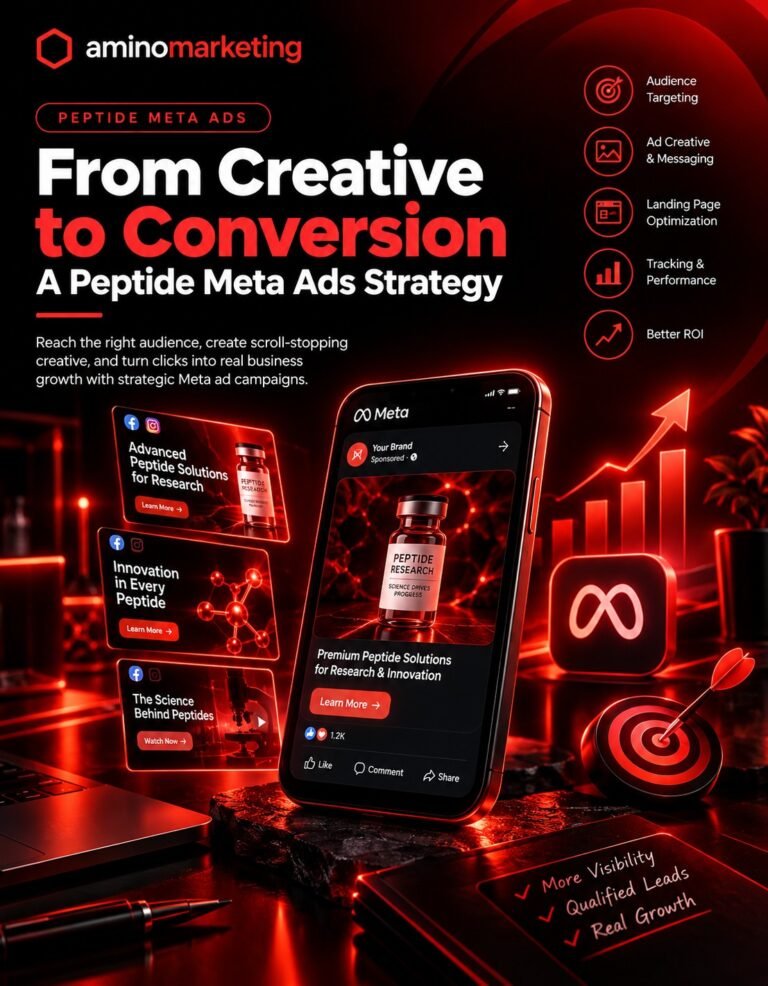
Meta Ads can give peptide businesses a powerful way to reach new audiences through Facebook and Instagram. But running successful campaigns requires more than creating an ad, choosing an audience, and setting a budget.
For peptide businesses, the advertising approach needs to consider the brand, audience, creative direction, landing page experience, campaign objective, tracking, and the advertising policies that apply to the products and claims being promoted.
This makes peptide Meta Ads a specialized area of digital marketing.
At Amino Marketing, we help businesses think about paid social as part of a wider digital marketing system. The goal is to create campaigns that connect the right audience with relevant messaging, strong creative, and a website experience designed to support the next step.
Why Peptide Meta Ads Require a Different Approach
Peptide businesses operate in a specialized market where audiences can have very different interests and levels of knowledge.
Some people may already be familiar with peptide-related topics, while others may first discover a brand through educational content or broader industry messaging.
This means your ads should not rely on one generic message.
A strong peptide Meta Ads campaign starts by understanding:
- Who the campaign is designed to reach.
- What the audience already knows.
- What information they are looking for.
- What action the campaign is designed to generate.
- Which messaging and creative are appropriate for the applicable advertising policies.
The more clearly these elements are defined, the easier it becomes to build a focused campaign.
Start With the Right Campaign Objective
Before creating an ad, decide what you actually want the campaign to accomplish.
Different campaigns can have different objectives, such as generating qualified leads, increasing website engagement, promoting educational resources, or building awareness.
For example, a peptide business launching a new educational resource may have a very different campaign objective from a company trying to generate inquiries for a marketing service.
The campaign objective should influence the creative, landing page, audience, and measurement approach.
Build a Clear Audience Strategy
Audience research is an important part of peptide Meta Ads.
Rather than trying to reach everyone interested in peptides, businesses can develop audiences around relevant characteristics and permitted targeting options.
Depending on the campaign and applicable Meta rules, audience planning may consider factors such as:
- Geographic markets.
- Broad audience characteristics.
- Website engagement where permitted.
- Existing customer or lead data where legally obtained and permitted.
- Engagement with the brand’s content.
- Different stages of the customer journey.
Meta’s tools and targeting options can change over time, so campaigns should be planned using the targeting features currently available in Ads Manager.
Create Ads That Stop the Scroll
Creative is one of the most visible parts of a Meta campaign.
Users scroll quickly through Facebook and Instagram, so your advertisement needs to communicate its message clearly without requiring a long explanation.
For a peptide brand, creative could focus on the company’s identity, educational content, research-oriented information, website experience, or other permissible messaging depending on the campaign.
Strong creative usually has a clear visual hierarchy:
Attention → Message → Value → Next Step
Instead of overcrowding the image with text, use a strong visual and let the headline and primary text provide the supporting context.
Use Different Creative Formats
A single image should not be the only creative format tested in a campaign.
Meta provides multiple placements and formats across its platforms, including Reels. Meta recommends creative built specifically for Reels, including vertical 9:16 video with key elements kept within the safe zone.
For a peptide brand, creative testing could include:
- Short educational videos.
- Product or brand-focused visuals where permitted.
- Founder or team content.
- Educational carousels.
- Website demonstrations.
- Research-focused visual content.
- Brand storytelling.
- Short-form Reels.
The goal is not to create dozens of random ads. It is to test different creative concepts and identify which messages resonate with the intended audience.
Make the Ad and Landing Page Match
One of the most important parts of peptide Meta Ads happens after the user clicks.
If an advertisement promises one thing but the landing page provides something completely different, the customer journey becomes disconnected.
For example, if the ad promotes an educational resource, the visitor should arrive directly at that resource rather than being sent to a generic homepage.
The journey should feel natural:
Meta Ad → Relevant Landing Page → Useful Information → Next Action
This is where your website becomes an important part of your paid marketing strategy.
Build Landing Pages for Campaigns
A dedicated landing page can give a campaign a much clearer destination.
Instead of sending every visitor to the homepage, businesses can create pages around specific campaigns, audiences, services, or educational resources.
A strong landing page should have:
- A clear headline.
- Messaging that matches the advertisement.
- Relevant supporting information.
- A focused CTA.
- Simple navigation.
- Mobile-friendly design.
- Fast loading performance.
For businesses investing in peptide website design, landing pages should be considered part of the paid advertising experience rather than a separate website task.
Connect Meta Ads With Your Website
Your website is where much of the visitor journey takes place after someone interacts with an advertisement.
That means the website should be prepared to receive paid traffic.
Important areas include page speed, mobile usability, navigation, content structure, forms, calls to action, and analytics.
A strong website can also give your campaigns more flexibility because different ads can be connected to different landing pages.
This is one reason peptide Meta Ads and peptide website design can work together as part of a larger digital marketing system.
Use Retargeting Carefully
Retargeting can help businesses reconnect with people who have previously interacted with their website or content, where the relevant audience and advertising features are permitted.
For example, a visitor may read an educational article but leave without taking another action. A future campaign could potentially reconnect with eligible audiences through appropriate content or messaging.
However, health-related and sensitive information requires particular care. Meta’s terms and privacy rules govern how customer data and custom audiences can be used, and advertisers need the appropriate rights and lawful basis for data they provide.
Retargeting should therefore be planned with both campaign objectives and privacy requirements in mind.
Test Your Ad Creative
One of the biggest mistakes in paid advertising is assuming that the first creative will be the best-performing one.
Instead, testing can compare different elements such as:
- Headlines.
- Primary text.
- Images.
- Video concepts.
- CTAs.
- Landing pages.
- Audience approaches.
- Creative formats.
For example, one campaign could test a product-focused visual against an educational visual, while keeping other variables relatively consistent.
This gives the marketing team useful information about which creative direction deserves further development.
Monitor the Right Metrics
Clicks alone do not tell you whether a campaign is working toward its actual objective.
The metrics you monitor should depend on what the campaign is designed to accomplish.
Useful metrics can include:
- Impressions.
- Reach.
- Click-through rate.
- Cost per click.
- Landing page views.
- Leads or inquiries.
- Cost per lead.
- Conversion rate.
- Return on ad spend where applicable.
- Frequency.
Looking at these metrics together provides a clearer picture of campaign performance.
For example, an advertisement may receive many clicks but generate few meaningful actions. That could indicate an issue with the audience, creative, landing page, offer, or overall customer journey.
Avoid Overly Aggressive Advertising Claims
Peptide advertising requires careful attention to messaging.
Businesses should avoid unsupported health claims, guaranteed outcomes, misleading statements, or language that could violate applicable advertising policies.
Meta’s platform rules also restrict certain types of content and transactions, including some pharmaceutical and regulated-product activity.
For this reason, campaign messaging should be reviewed before launch rather than assuming that a claim is acceptable simply because a competitor appears to use similar language.
A safer approach is to build campaigns around accurate brand information, educational resources, permitted services, and properly supported messaging where appropriate.
Use Content to Support Peptide Meta Ads
Paid advertising does not always need to send visitors directly toward a commercial action.
Educational content can also play a role in the customer journey.
For example, a peptide brand could promote an appropriate educational resource that introduces visitors to a topic before directing them toward other relevant information.
This approach can be especially useful when audiences are unfamiliar with the brand.
It also connects peptide Meta Ads with broader peptide content marketing, SEO, and website strategy.
Connect Meta Ads With Other Marketing Channels
Meta advertising works best when it is not treated as an isolated activity.
A campaign can work alongside:
- SEO.
- Peptide content marketing.
- Email marketing.
- Website optimization.
- Ecommerce.
- Brand development.
- Conversion rate optimization.
For example, an SEO article can build organic visibility while Meta Ads introduce the brand to new audiences. Email marketing can then help maintain communication with people who have opted into appropriate communications.
This creates a broader peptide marketing ecosystem where multiple channels support the same brand.
Work With a Peptide Marketing Agency
Managing paid social campaigns can become more complicated as a business grows.
A peptide marketing agency can help coordinate campaign planning, creative development, landing pages, tracking, testing, and optimization while keeping the wider marketing strategy in view.
For peptide businesses, specialized knowledge can also help teams think more carefully about messaging, website structure, audience journeys, and platform requirements.
Instead of treating Meta Ads as simply an advertising channel, the campaign can become part of a larger digital growth system.
Why Amino Marketing for Peptide Meta Ads
At Amino Marketing, we approach paid marketing with the wider digital journey in mind.
Our services can connect peptide Meta Ads with website development, SEO, content marketing, email marketing, Google Ads, and conversion-focused digital strategies.
This means the advertisement is not treated as the end product. We consider what happens before the click, after the click, and throughout the customer journey.
The exact advertising approach depends on the business, market, products, audience, and current platform requirements.
Build a Smarter Paid Social Strategy
Successful peptide Meta Ads are built around more than a good-looking creative.
They require clear objectives, relevant audiences, strong messaging, appropriate landing pages, useful data, ongoing testing, and careful attention to advertising policies.
For peptide businesses, combining paid social with peptide marketing, SEO, website development, content, and other digital channels can create a more connected online presence.
Amino Marketing helps peptide businesses build that connection through specialized digital marketing services designed around their brand and growth objectives.
Ready to improve your peptide brand’s paid social presence?
Connect with Amino Marketing to explore a paid marketing approach built around your audience, website, brand, and digital growth goals.
FAQs About Peptide Meta Ads
What are peptide Meta Ads?
Peptide Meta Ads are paid advertising campaigns on Meta platforms such as Facebook and Instagram created for businesses operating in the peptide industry, subject to applicable platform policies and regulations.
Can peptide businesses advertise on Facebook and Instagram?
Eligibility depends on the products, claims, campaign content, destination, market, and Meta’s current advertising policies. Businesses should review the applicable rules before launching campaigns.
What should peptide Meta Ads focus on?
Campaigns can focus on appropriate brand awareness, educational content, permitted services, or other objectives depending on the business and what Meta allows for the specific offering.
Are Facebook Ads and Instagram Ads the same?
Both can be managed through Meta Ads Manager, but the creative and user experience can differ between placements. Campaigns should consider the format and context of each placement.
Why is the landing page important for Meta Ads?
The landing page determines what happens after someone clicks the advertisement. A relevant, fast, mobile-friendly page can create a more consistent journey from the ad to the desired next action.
How can a peptide marketing agency help with Meta Ads?
A peptide marketing agency can help with campaign planning, creative, audience research, landing pages, tracking, testing, and optimization while connecting paid advertising with the wider marketing strategy.
How should peptide businesses approach Meta advertising policies?
Businesses should review Meta’s current Advertising Standards and relevant policies before launching campaigns, particularly when products or claims involve health, pharmaceuticals, or other regulated areas. Policies can change, so previous campaign approval does not guarantee future approval.